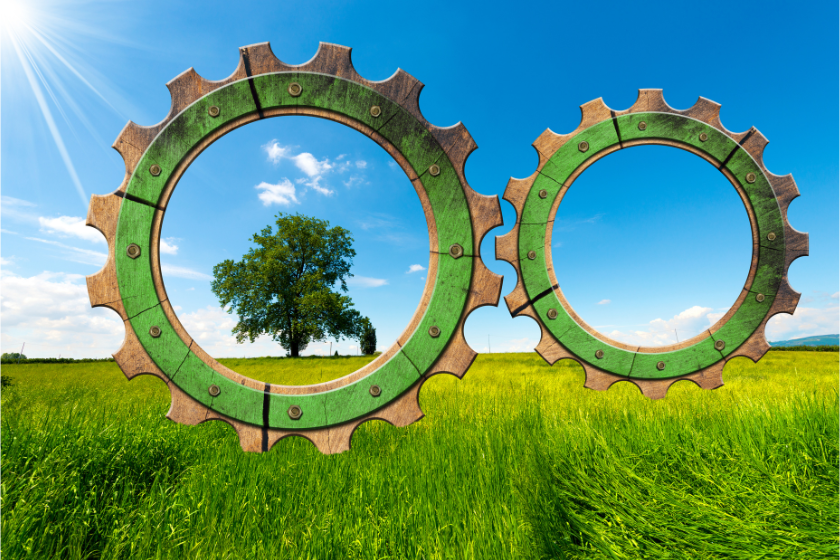
Circular economy for businesses is becoming one of the most important pillars of European economic policy. Businesses across Europe must now rethink their production models, reduce waste, use more recyclable packaging materials, and manage natural resources more efficiently.
For Greece, this transition creates a major opportunity. It can strengthen competitiveness and support a more resilient and sustainable economic model. This matters even more today, as the cost of materials across supply chains keeps rising due to geopolitical instability and market uncertainty.
The traditional linear economy followed a simple logic for decades: produce, consume, discard. This model supported growth, but it also increased pressure on natural resources. It deepened dependence on imported raw materials and led to higher levels of waste and greenhouse gas emissions.
Circular economy offers a different approach. Products and materials are reused, repaired, recycled, and kept for longer within the supply chain and consumption cycle. This shift changes the way companies think about value, cost, risk, and long-term competitiveness.
Circular Economy as a Business Strategy
The implementation of circular practices has become a strategy for business growth. Companies that invest in recycling, material reuse, sustainable product design, and waste reduction can achieve clear economic benefits.
Saving raw materials can reduce production costs. It can also protect companies from strong fluctuations in international energy and material prices. At the same time, investors and financial institutions now assess companies with stricter sustainability criteria.
Businesses that integrate circular operating models can improve access to financing. They can also strengthen their reputation in the market and reduce material costs over the medium term.
This is why circular economy should not be treated as a technical or environmental issue alone. It is now part of business strategy. It affects procurement, production, packaging, product design, logistics, reporting, and investor confidence.
The European Commission has already launched a public consultation for the new Circular Economy Act. This major legislative initiative aims to double the circularity rate of the European economy and create a single market for secondary raw materials. In parallel, new rules on packaging and packaging waste are expected to increase pressure on companies to improve recyclability and reduce waste.
For companies, circular economy for businesses is not only about recycling. It is about reducing dependency on raw materials, improving ESG performance, and preparing for stricter European rules. I have also discussed this regulatory shift in my related article, Circular Economy Regulation: Comply or Compete, where I explain why companies should treat circularity as a competitiveness issue rather than a compliance burden.
Challenges and Opportunities for Greece
Greece has significant room for improvement in circular economy. Despite progress in recent years, the country still records lower performance in recycling and material reuse compared with the European average. This gap appears especially clearly in waste management.
According to data mentioned in the original Energymag article, municipal waste recycling in Greece stood at 17% in 2022. This was far below the estimated EU average of 49% in the same year. This gap shows the need for better separate collection, modern recycling infrastructure, and a stronger connection between circular economy and business strategy.
Important opportunities exist in sectors with a strong Greek footprint, such as tourism, shipping, manufacturing, agri-food, energy, and construction.
In agri-food, for example, residues from olive mills, wineries, and food processing units can be used in new products or applications. In construction, better material management can reduce waste and create new value chains. In tourism, reducing plastics and food waste connects directly with the quality and reputation of the Greek tourism product.
These examples show that circular economy is not an abstract European policy. It is a practical tool for sectors that define the Greek economy.
The ESG Connection
The link with ESG is also crucial. For businesses, recycling is now only one part of a broader sustainability strategy. Markets, investors, and consumers increasingly focus on waste reduction, the selection of more sustainable materials, responsible suppliers, and systematic measurement of progress.
In this way, circularity strengthens the credibility of ESG data. It shows that sustainability has entered the daily operation of the business. It also helps companies move from general commitments to measurable action.
This is particularly important because ESG performance now depends on proof. Companies must show how they manage materials, resources, waste, suppliers, and environmental risks. Circular economy offers a practical framework for doing exactly that.
Practical Steps for Businesses
The next step for Greek businesses is practical. A useful starting point is the assessment of three key areas: the materials they use, the waste they generate, and the products or services they can design for a longer life cycle.
From this assessment, practical solutions can emerge. These may include reusable packaging, product repair, recycled materials, reduction of food waste, and partnerships with other companies to reuse by-products or materials.
The most successful companies will be those that do not wait for regulation to force change. They will act early, measure their progress, and turn circularity into a source of innovation.
Why It Matters Now
Circular economy is a key pillar for economic resilience, industrial competitiveness, and the long-term development of the country. Greek businesses can use the new European reality as an opportunity and turn circularity into a driver of growth.
Early adaptation to new requirements can strengthen their position in the market. It can also contribute to the creation of a more modern, competitive, and sustainable economy.
The message is clear: circular economy is not a future discussion. It is already reshaping business strategy, cost structures, and ESG expectations. Companies that adapt early will be better prepared. Companies that delay may simply pay more.
The article was published in greek media EnergyMag






 English
  Greek
Greek