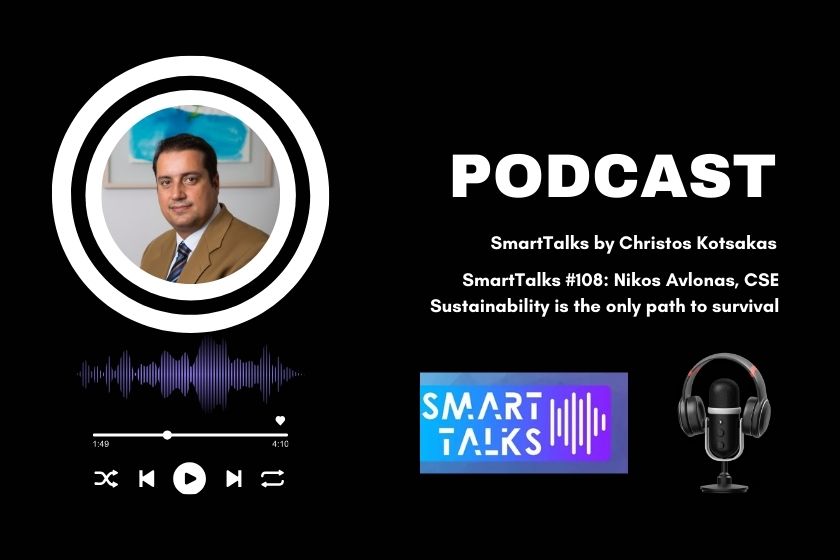
Introduction to ESG and the SmartTalks Podcast Interview
In a recent episode of the SmartTalks podcast, I had the opportunity to discuss the rapidly evolving role of sustainability in business strategy and the growing importance of ESG criteria in today’s global economy. The discussion focused on how environmental and social performance are transforming from voluntary corporate initiatives into measurable indicators of economic resilience and competitiveness.
You can listen the interview here or read the full interview here & here
During the conversation, I shared insights from my work at the Center for Sustainability and Excellence (CSE) and explained why the adoption of ESG standards has become essential for business resilience and access to international investment capital.
Today’s global economy is undergoing a structural transformation. Environmental and social performance are no longer optional initiatives or communication exercises. Instead, they increasingly function as hard indicators used by investors, regulators, and financial institutions to evaluate companies.
From my perspective, companies that fail to integrate ESG into their strategy now represent high-risk entities. Without credible sustainability practices, businesses risk losing access to financing, supply chains, and international markets.
Benefits of ESG Integration for Business Strategy
The adoption of ESG principles offers significant strategic advantages for companies.
- ESG improves access to global investment capital. Investors and financial institutions increasingly evaluate companies based on environmental and social performance indicators. Organizations that demonstrate credible ESG strategies attract more stable and long-term financing.
- ESG strengthens corporate resilience. Businesses that manage environmental risks, labor practices, and governance structures proactively are better prepared to navigate regulatory changes and market disruptions.
- ESG enhances reputation and trust. Stakeholders today expect transparency and responsible behavior. Companies that demonstrate genuine sustainability commitments build stronger relationships with customers, employees, and investors.
Through the work of CSE, which has trained more than 10,000 professionals from organizations representing nearly 90 percent of Fortune 500 companies, we consistently observe that sustainability leaders are also innovation leaders. Companies that embed ESG into strategy tend to outperform those that treat sustainability as a compliance exercise.
The Legislative “Tsunami” Transforming European Business
One of the most significant drivers of ESG adoption is the regulatory wave reshaping the European business landscape.
This transformation goes far beyond the implementation of the Corporate Sustainability Reporting Directive (CSRD). New frameworks such as the EU Taxonomy and the European Climate Law are fundamentally changing how companies operate.
These regulations require organizations to measure environmental impact, disclose sustainability data, and ensure external assurance of their reporting. Sustainability reporting is therefore no longer a marketing tool but a strategic management process that requires reliable data and governance structures.
In my view, this regulatory transformation is irreversible. Governments and international institutions are moving toward stricter sustainability requirements. As a result, companies must abandon passive approaches and adopt proactive ESG strategies that ensure long-term competitiveness.
ESG Pressure Across Global Supply Chains
Another powerful force accelerating ESG adoption comes from multinational supply chains.
Large international corporations are now required to conduct detailed due diligence on their suppliers regarding issues such as carbon emissions, labor conditions, and human rights practices. These expectations are rapidly becoming standard in global markets.
For export-oriented economies such as Greece, this development carries significant implications. Thousands of companies that participate in global value chains risk exclusion if they fail to meet ESG expectations.
Businesses must therefore invest in training, evaluation systems, and internationally recognized sustainability standards. Protecting corporate reputation and ensuring transparency have become key priorities for multinational partners.
Common Mistakes to Avoid in ESG Implementation
Many companies still misunderstand ESG implementation.
One common mistake is treating sustainability as a simple certification or communication exercise. Another is focusing on producing a sustainability report without implementing operational change.
Effective ESG strategy requires measurable targets, reliable data, and integration across departments. Without this commitment, companies risk reputational damage and accusations of greenwashing.
Why ESG Now Determines Access to Finance
Perhaps the most powerful driver of ESG transformation comes from the financial sector.
ESG criteria now directly influence lending decisions, financing conditions, and corporate risk assessments. Since 2023, major financial institutions have implemented strict evaluation frameworks consisting of numerous sustainability criteria that classify companies according to their ESG risk profile.
For businesses seeking capital, the ability to present credible ESG data has become essential. Sustainability performance increasingly affects creditworthiness and borrowing costs.
In many cases, this financial pressure is even more influential than regulation itself. Companies that ignore ESG considerations risk facing financial constraints and declining competitiveness in modern capital markets.
The Role of Family Businesses in the Sustainability Transition
Family-owned companies also play a crucial role in the sustainability transition.
Generational change often creates an opportunity to integrate ESG principles into corporate strategy. Younger leaders tend to show greater awareness of environmental and social challenges, making sustainability a powerful bridge between tradition and innovation.
However, when founders perceive ESG as unnecessary cost rather than strategic investment, they expose their organizations to significant risks. Businesses that fail to adapt to global sustainability trends may struggle to remain competitive.
By integrating ESG into succession planning and corporate governance, family businesses can strengthen both resilience and long-term value creation.
Circular Economy as the Next Strategic Frontier
Looking ahead, the circular economy is emerging as the next critical dimension of corporate sustainability.
Increasing scarcity of raw materials makes it essential for companies to rethink production models and product design. Circular approaches that emphasize reuse, recycling, and resource efficiency can significantly reduce costs and supply chain risks.
At CSE, we are already developing global rating systems that measure material reuse and circularity. These initiatives respond to a growing realization: current consumption patterns are unsustainable, and businesses must adapt to a more resource-efficient economic model.
Final Thoughts on the Future of Sustainable Business
Despite the complexity of the transition, I remain optimistic about the future of business transformation.
Companies that embrace sustainability as a strategic opportunity will lead the next wave of innovation. Those that invest in ESG capabilities, transparent governance, and sustainable product design will remain competitive in increasingly demanding global markets.
The message is clear. Sustainability is the foundation of resilient and responsible business.








 English
  Greek
Greek