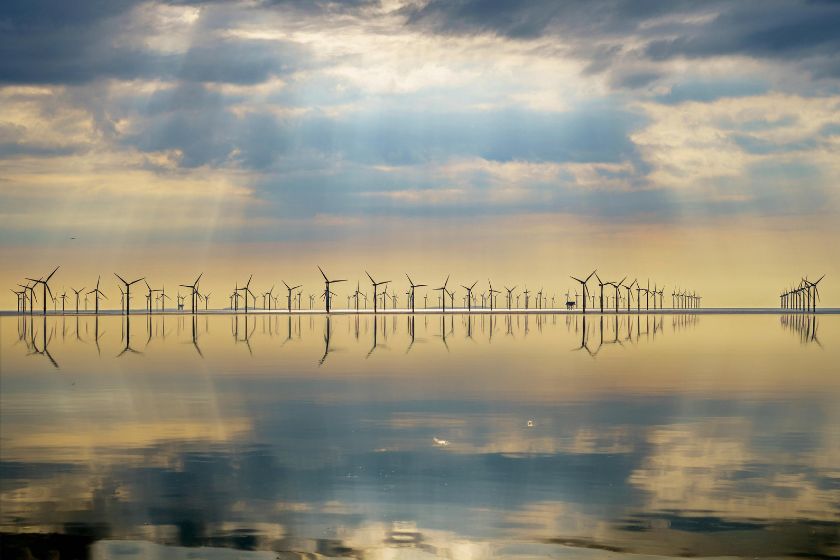
Introduction to Offshore Wind Policy
In my 20+ years advising organizations on sustainability strategy, I have rarely seen such a sharp policy divergence in a critical sector of the energy transition.
Two recent developments highlight this shift.
In the United States, the government agreed to pay TotalEnergies nearly $1 billion to terminate offshore wind projects. This decision raises serious questions about policy consistency and investor confidence.
At the same time, the European Commission approved a €5 billion Danish offshore wind program, reinforcing its long-term commitment to renewable energy expansion.
But the European momentum does not stop there.
A new partnership between the European Investment Bank and Société Générale aims to unlock €8 billion in financing for wind energy projects across Europe. This initiative further demonstrates how financial institutions are actively de-risking renewable investments and accelerating deployment.
This is not simply a regional difference. It signals a deeper fragmentation in how major economies approach decarbonization, energy security, and ESG priorities.
According to the International Energy Agency, global clean energy investment surpassed $1.7 trillion, with renewables leading growth. Yet capital is increasingly flowing toward stable policy environments.
This is where the real story lies.
Benefits of Offshore Wind Policy Alignment
Policy alignment is not just a regulatory issue. It directly shapes market outcomes.
- it reduces investment risk. Europe’s combination of public funding, regulatory clarity, and blended finance mechanisms, such as the EIB partnership, lowers financing costs and attracts institutional investors.
- it strengthens industrial ecosystems. Denmark and broader EU markets have built a competitive offshore wind value chain supported by long-term policy signals.
- it enhances ESG performance. Companies operating in stable policy environments can more effectively meet Science-Based Targets and disclosure requirements such as CSRD and TCFD.
However, the U.S. case introduces a different reality.
Abrupt policy reversals increase uncertainty across the entire value chain. Developers, suppliers, and corporate buyers face delays, renegotiations, and potential financial losses.
A Morgan Stanley survey shows that 88% of companies see sustainability as a value creation opportunity. Yet policy inconsistency can undermine execution and delay returns.
Common Mistakes to Avoid
Based on my advisory experience, three critical mistakes stand out.
The first is assuming policy stability. Many organizations treat renewable energy incentives as permanent.
The second is ignoring geopolitical risk. Offshore wind is now closely tied to national energy security and economic competitiveness.
The third is underestimating stranded asset exposure. Cancelled or delayed projects can quickly impact financial performance and ESG ratings.
Practical Steps, Tools, or Best Practices
To navigate this increasingly complex landscape, ESG leaders must evolve their approach.
Step 1: integrate geopolitical intelligence into ESG strategy. Energy policy decisions now reflect broader economic and security priorities.
Step 2: adopt scenario-based planning. Organizations should model policy acceleration, stagnation, and rollback scenarios.
Step 3: diversify renewable energy portfolios. Overreliance on a single geography increases exposure to regulatory shifts.
Step 4: strengthen internal ESG expertise. Understanding frameworks such as the EU Green Deal, REPowerEU, and global financing mechanisms is essential.
Step 5: engage in policy dialogue. Companies that participate in industry discussions can better anticipate regulatory changes.
From my perspective, the next phase of the energy transition will not be defined by technology alone. It will be defined by governance, capital flows, and policy consistency.
Europe is building momentum through aligned policy and financing.
The U.S. is introducing uncertainty through political intervention.
For ESG professionals, this divergence is no longer theoretical. It is operational and immediate.
FAQs
What is offshore wind policy in simple terms?
Offshore wind policy includes government rules, incentives, and financing mechanisms that support or restrict wind energy projects at sea.
How long does it take to develop offshore wind projects?
Most projects take 5 to 10 years due to permitting, financing, and infrastructure complexity.
Is offshore wind policy important for ESG careers?
Yes. ESG professionals must understand renewable energy policy to assess risks, guide corporate strategy, and align with global sustainability frameworks.









 English
  Greek
Greek